
AI Generated Image
Urgent alert for H-1B workers and employers. The Labor Department’s rule raising H-1B prevailing wages reached the White House as a final rule on Nov. 6, 2026 (RIN 1205-AC30). Review at the Office of Information and Regulatory Affairs (OIRA) can end on any day, and publication in the Federal Register follows soon after. Most likely, once the rule takes effect, every new Labor Condition Application (LCA) will have to meet much higher wage floors. LCAs certified before then should keep today’s levels. That gap is the window to act. (Full background: H-1B Prevailing Wage Rule Goes to White House as Final Rule.)
What is about to change
Under the March 2026 proposal, every wage level moves up by about 17 to 21 percentile points. The final text has not been released, so the final numbers could differ.
| Wage level | Today (approx. percentile) | Proposed (percentile) |
|---|---|---|
| Level I (entry) | 17th | 34th |
| Level II | 34th | 52nd |
| Level III | 50th | 70th |
| Level IV | 67th | 88th |
In practice, a new Level I wage would land about where Level II sits today. For many IT consulting firms, startups and employers hiring recent graduates, that may put H-1B sponsorship out of reach.
What it means in dollars
Take the most common H-1B job, Software Developer (SOC 15-1252). We pulled today’s official prevailing wages from the Labor Department’s FLAG wage search for the current July 2026 to June 2027 data year, then estimated the new floors at the proposed percentiles:
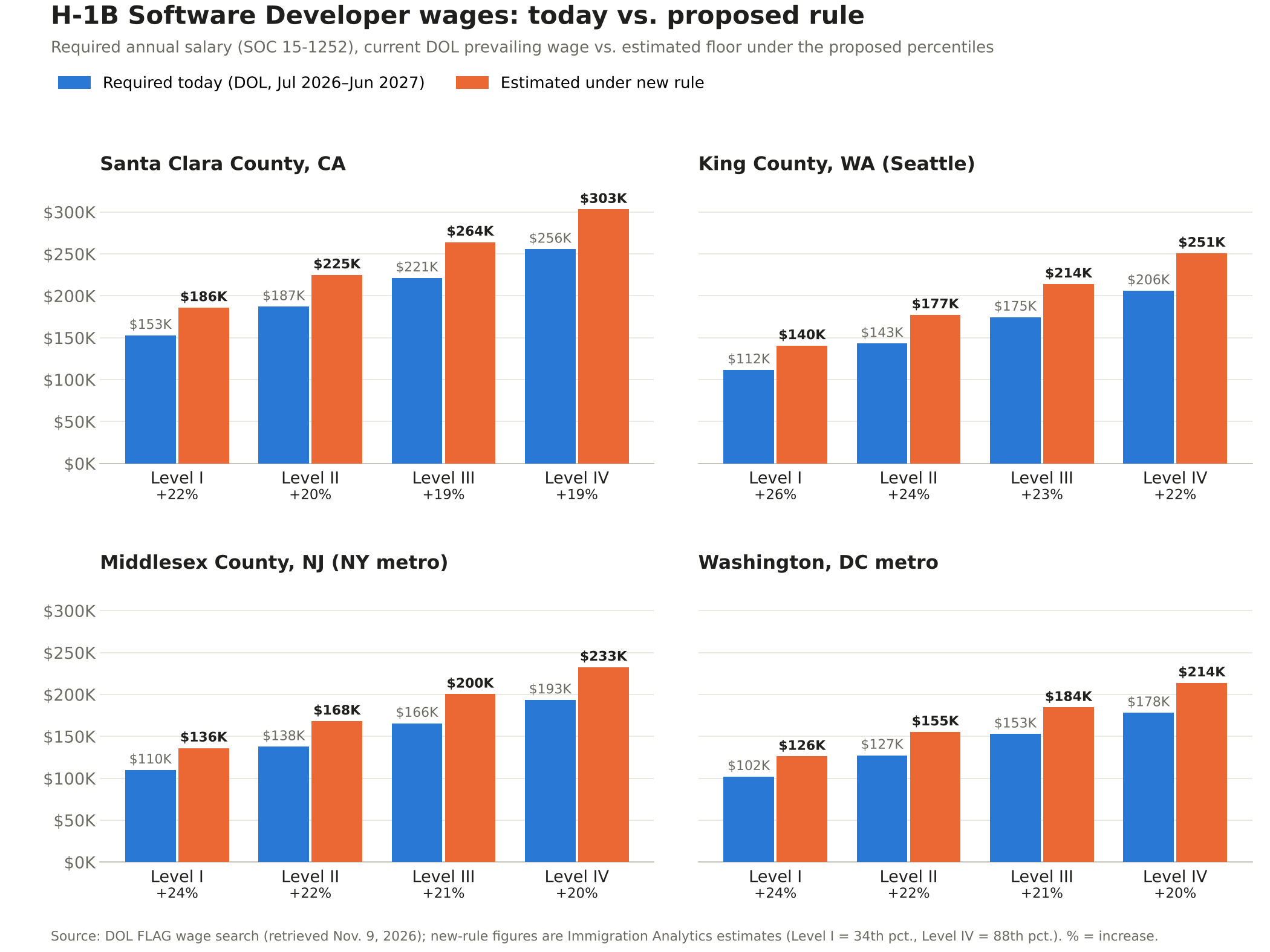
| Area | Level | Required today | Est. new rule | Increase |
|---|---|---|---|---|
| Santa Clara County, CA | I | $152,797 | ~$185,900 | +$33,100 (22%) |
| Santa Clara County, CA | II | $187,075 | ~$225,000 | +$37,900 (20%) |
| Santa Clara County, CA | III | $221,374 | ~$264,100 | +$42,700 (19%) |
| Santa Clara County, CA | IV | $255,653 | ~$303,100 | +$47,500 (19%) |
| King County, WA (Seattle) | I | $111,613 | ~$140,500 | +$28,900 (26%) |
| King County, WA (Seattle) | II | $143,104 | ~$177,300 | +$34,200 (24%) |
| King County, WA (Seattle) | III | $174,595 | ~$214,100 | +$39,500 (23%) |
| King County, WA (Seattle) | IV | $206,086 | ~$250,800 | +$44,700 (22%) |
| Middlesex County, NJ (NY metro) | I | $109,845 | ~$136,100 | +$26,200 (24%) |
| Middlesex County, NJ (NY metro) | II | $137,717 | ~$168,200 | +$30,500 (22%) |
| Middlesex County, NJ (NY metro) | III | $165,589 | ~$200,400 | +$34,800 (21%) |
| Middlesex County, NJ (NY metro) | IV | $193,461 | ~$232,600 | +$39,100 (20%) |
| Washington, DC metro | I | $102,086 | ~$126,100 | +$24,000 (24%) |
| Washington, DC metro | II | $127,462 | ~$155,300 | +$27,800 (22%) |
| Washington, DC metro | III | $152,838 | ~$184,500 | +$31,700 (21%) |
| Washington, DC metro | IV | $178,214 | ~$213,800 | +$35,500 (20%) |
The pattern holds in every market: roughly $24,000 to $48,000 more per worker per year, an increase of about 19% to 26%. Entry-level jobs see the largest percentage jumps.
Two examples
- Extension in Santa Clara. A software developer at Level II earns $190,000, which clears today’s $187,075 floor. If the extension LCA is filed after the rule takes effect, the floor rises to about $225,000. The employer must raise pay by roughly $35,000, about 18%, or the extension cannot be filed at that level. An LCA certified now keeps the $187,075 floor for the length of the new approval, up to three years.
- Transfer in New Jersey. A consulting firm hires a Level I developer in Middlesex County at $112,000, just above today’s $109,845. After the rule, the floor is about $136,100. That is roughly $24,000 more a year, before vendor and end-client margins are taken out of the bill rate. For many layered consulting arrangements, the placement no longer works.
Across a team of 20 such workers, the difference is roughly $500,000 to $750,000 a year in added payroll.
Who needs a new LCA
The proposal applies the new wages to LCAs filed on or after the effective date. It does not reopen LCAs already certified. Most H-1B filings that need a fresh LCA would be caught, including:
- Extensions when the current LCA expires or does not cover the new period
- Transfers (change of employer, including portability filings)
- Amendments for a new worksite outside the current area, or a material change in the job
- New hires, including H-1B cap-exempt hires and change-of-status cases
- E-3 and H-1B1 workers, who use the same LCA
H-1B workers: what to do today
- Check your dates. Find the end date on your I-797 and on your current LCA. If either falls within the next six months, you are in scope.
- Ask your employer, in writing, to file the LCA now. Email HR or your manager and copy the immigration team. Ask for the LCA to be filed for your upcoming extension or amendment, even if the I-129 petition itself is filed later.
- Changing jobs? Ask your new employer to file the LCA for your transfer immediately, before the start date is finalized.
- Moving to a new client site or city? Raise it now. A worksite change outside your current area usually needs a new LCA and an amended petition.
- Get confirmation. Ask for the LCA case number and the date it was certified.
Employers: build your list this week
The bottleneck is usually internal, not the Labor Department. HR and the immigration team should pull the data first, then hand the list to counsel to file.
- Extensions: every H-1B, E-3 and H-1B1 worker whose status or LCA ends in the next six months.
- Amendments: anyone expected to change worksite, client, job duties, hours or salary band.
- Transfers and new hires: accepted offers, offers going out in the next few days, and candidates likely to join in the coming months.
- Job details for each: job title, SOC code, worksite address, wage level and offered salary.
- File and post: send the list to your immigration attorney, complete the LCA notice posting, and file. Certification usually takes about seven business days, so do not wait for the rule to publish.
Know the limits
- Six-month window. An LCA cannot be filed more than six months before the employment start date it covers. Filings needed later than that cannot be locked in now.
- The job must be real. An LCA must match an actual position, worksite and wage. Speculative or placeholder LCAs create compliance risk.
- Changes later mean a new LCA. If the worksite or job changes after the rule takes effect, the new LCA will carry the new wage.
- PERM is different. Under the proposal, prevailing wage requests still pending on the effective date get the new levels. Only an issued determination protects a green card case, so file PWD requests now, knowing they may not be decided in time.
Don’t count on litigation
A legal challenge is likely. The 2020 wage rule was struck down because it skipped public comment, but this rule went through full notice and comment, so any lawsuit would have to win on the merits. No one can predict how a court will rule or how long it will take. A certified LCA in hand is certain; a future injunction is not.
Bottom line: If an extension, transfer, amendment or new hire is coming up in the next six months, get the LCA certified now under today’s wages.
This article is for general information and is not legal advice. Talk to your immigration attorney about your specific case.
Sources
- OIRA (Reginfo.gov): EO 12866 review, RIN 1205-AC30, final rule received Nov. 6, 2026
- Federal Register: proposed rule, 91 FR 15454 (March 27, 2026)
- Regulations.gov: docket ETA-2026-0001
- DOL FLAG: OFLC Wage Search, SOC 15-1252, July 2026–June 2027 data
About the Author


